
Perfumery Training and Quality Control: Checkpoints for a Kids-Safe Line
A kids-safe fragrance line is won in training and checkpoints before the first drop is manufactured. The people who build, evaluate and release the scent have to agree on what 'safe for children' means in practice — restricted materials, use levels, allergens, packaging and labelling — and every release has to pass the same checks. A factory with trained perfumers, a documented evaluation protocol and a defined release gate gives you a verifiable process; an untrained team gives you promises.
Key takeaways
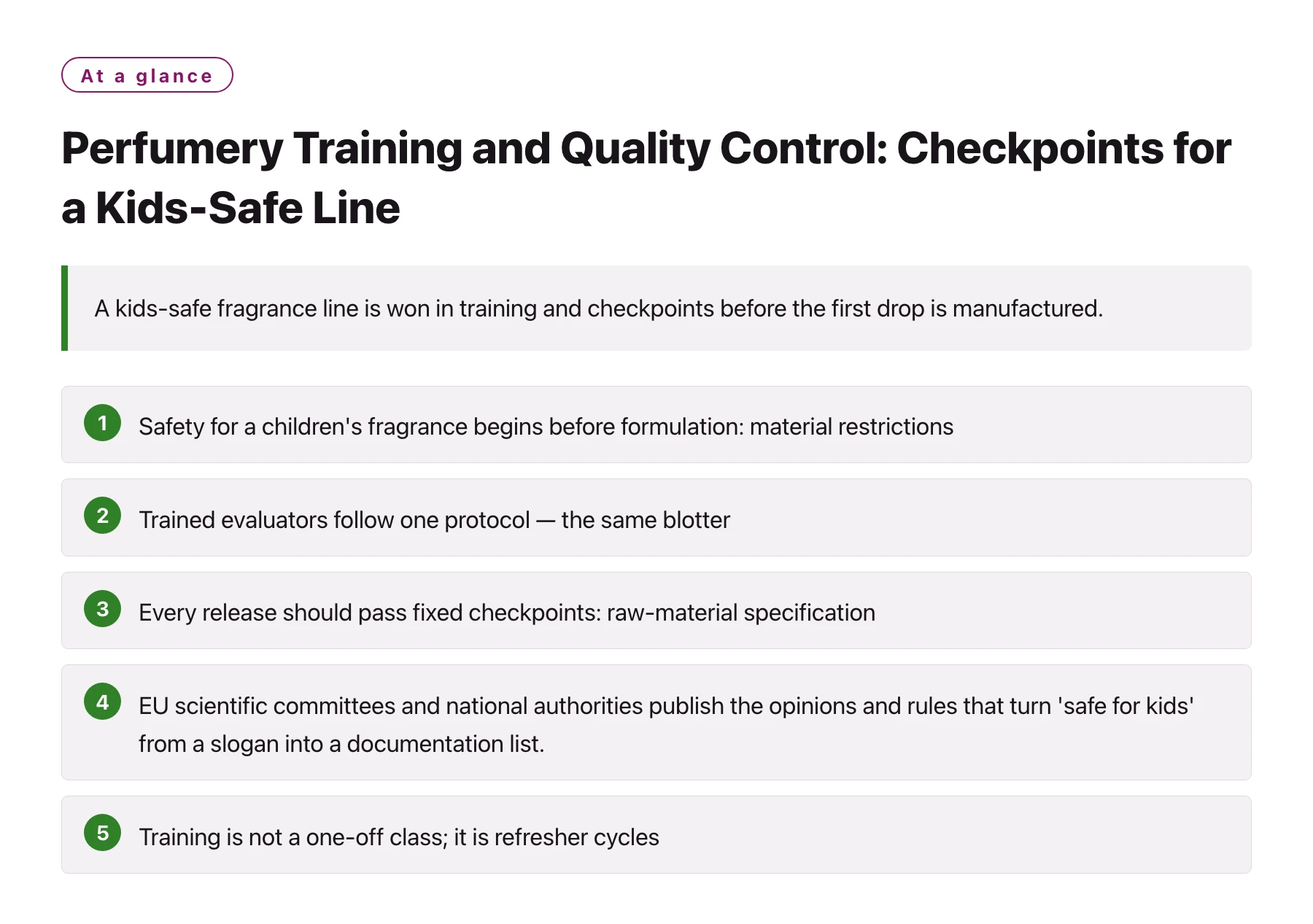
- Safety for a children's fragrance begins before formulation: material restrictions, use levels and allergen review must be settled against the intended product category.
- Trained evaluators follow one protocol — the same blotter, the same timing, the same scoring — so 'it smells strong' stops meaning different things on different days.
- Every release should pass fixed checkpoints: raw-material specification, safe-use review, stability, microbial and packaging checks, label review and a retained sample.
- EU scientific committees and national authorities publish the opinions and rules that turn 'safe for kids' from a slogan into a documentation list.
- Training is not a one-off class; it is refresher cycles, blind test panels and audits, and it has to cover the people who write the batch records, not only the perfumers.
A children's fragrance product is bought by parents who search for the word 'safe' and read every label line twice. That reality lands on the manufacturer long before the bottle: the category punishes a scent that is allergenic, unstable or mislabelled more brutally than any adult line, and it punishes the brand in public.
The two assets that survive that pressure are trained people and fixed checkpoints. Training standardises how a team smells, scores and records; checkpoints standardise what may leave the building. Neither replaces the other, and both are cheaper than one recall.
This article sets out the training sequence, the safety and QC gates for a kids-safe release, and the questions to ask a manufacturer before you trust its process.
The training checkpoints, in order
- Set the safety briefProduct form, age range, exposure and markets are settled before any scent is mixed, and the team learns to read it as a constraint, not a form.
- Material familiarisationPerfumers learn the restricted and allergen-sensitive materials that matter for the category, and where to check them during formulation.
- Evaluation protocolOne way to assess: the same blotter, the same timing, one feature scored per point, blind codes on every panel.
- Release-gate practiceTrainees run the batch-record review, not just the sniffing, so the gate checks documents as well as noses.
- Refresher and auditPeriodic blind re-tests, rule-change updates and record audits keep the protocol from quietly drifting after a busy season.
Why trained people are a quality-control step
The nose as an instrument
A trained evaluator does not taste less than a customer — the evaluator is slower and more standard. The protocol turns subjective impressions into scores at fixed times, which is the only format a batch record can actually use. Without the training, the same panel will call one sample 'too weak' on Monday and 'just right' on Friday.
The record as the product
For a kids-safe line, the batch record is the product: it links the approved reference to every batch released and shows the checks that were passed. That is why training has to include the people who write the records. A team that can smell but cannot document produces approvals that dissolve in an audit.
Where the training comes from
Some manufacturers run a serious training arm of their own; a factory with a fragrance academy — Xuelei's academy, for example, says it works with ISIPCA on perfumery courses and masterclasses — can keep its evaluators current without sending the whole team overseas. The point is not where the nose was trained; it is whether the protocol is written and the refresher cycle exists.
Safety and QC checkpoints for a kids-safe release
| Checkpoint | What it verifies | Who signs it |
|---|---|---|
| Raw-material specification | Identity, purity and supplier lot of every material | Purchasing with QC |
| Safe-use and allergen review | Use level in the finished product, restricted substances | Perfumer with regulatory |
| Stability and microbial checks | Odor, colour, clarity and preservation under planned storage | QC laboratory |
| Packaging safety | Child-resistant closures where expected, leak safety, warnings | Packaging with QC |
| Label and language review | Allergens, warnings and market-specific requirements | Regulatory |
| Retained sample | A sealed reference from the approved batch | QC |
The list is not exotic — the same gates protect an adult line. The kids-safe difference is that the gates cannot be skipped for schedule, and that the safe-use review carries more weight because the user is smaller and the buyer is more anxious.
The knowledge that feeds the checkpoints
None of these gates runs on opinion. Scientific bodies weigh in on ingredient safety — the EU's Scientific Committee on Consumer Safety publishes opinions on cosmetic ingredients that regulators and formulators treat as inputs [1]. For fragrance materials specifically, safe-use standards restrict how a material may be used in a product category, which is the baseline every kids-safe brief must be checked against [2]. And national rules do the final gatekeeping: in markets such as Canada, cosmetics must be notified and meet safety requirements before sale, and a children's product is reviewed against the same law with stricter eyes from buyers and media [3].
The practical consequence for a brand: 'kids-safe' is a documentation claim. If the supplier cannot show the material restrictions, the safe-use review, the stability data and the label review for the batch, the phrase is marketing, not quality control.
Where the manufacturer fits
Running formulation, filling and QC under one roof — fragrance manufacturing under one roof — shortens the loop between a failed checkpoint and the fix, because the people who failed the gate are the people who can change the process. And you can see the shape of a serious operation on its own pages: the Xuelei website publishes the certifications the company works to, which gives you a concrete list to verify before you brief a kids-safe project.
A 'kids-safe' claim is a documentation claim. If the supplier cannot show the material restrictions, the safe-use review, the stability data and the label review for the batch, the phrase is marketing, not quality control.
Sources
- EU Scientific Committee on Consumer Safety (SCCS) —— The EU scientific committee that issues opinions on the safety of cosmetic ingredients, including fragrance allergens and their labelling thresholds.
- IFRA: Safe Use and Fragrance Science —— IFRA's explanation of how fragrance materials are scientifically assessed for safe use and how those conclusions are applied by the industry.
- Health Canada: Cosmetic Safety —— Health Canada's cosmetics pages, covering cosmetic notification, the ingredient hotlist and safety requirements for cosmetics sold in Canada.
Frequently asked questions
Is there a special 'kids-safe' certification for perfume?
There is no single universal badge. Safety comes from meeting the rules of each destination market, applying restricted-material and allergen reviews, and documenting the batch. Treat any claimed certification as something to verify, not something to assume.
Which restrictions matter most for children's fragrance?
The ones that limit materials or force labelling — restricted substances and fragrance allergens above thresholds, for example. The exact list depends on the product category and the markets, so fix the market list before formulation.
Do I need a trained perfumer on staff?
You need trained people running evaluation and release; that can be the factory's team, provided the protocol is written, the records exist and the refresher cycle is real. Verify the process, not the job titles.
Can I use the same scent I sell to adults, just milder?
Dilution is not a review. Changing the use level or the product category changes the safety and stability questions, so a 'milder' version needs its own safe-use check, stability work and label review.
How do I verify a manufacturer's training claims?
Ask for the evaluation protocol, blind test records, and the named people who sign each release; then audit one batch record end to end. Claims about courses matter far less than the documents that survive an audit.